Emergency Water Kit & Storage Guide: How Much to Store & Best Containers
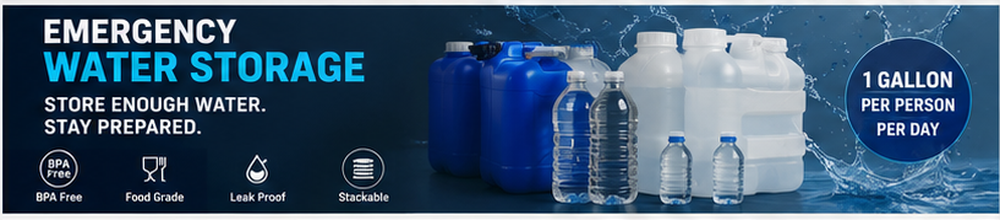
Water is the most critical emergency supply you can store: yet most households have none. You can survive three weeks without food. Without water, you have three days. An emergency water kit covers the quantity you need, the right containers to store it in, how to rotate it safely, and what to do when your stored supply runs out. This guide covers all of it.
What Should an Emergency Water Kit Include?
An emergency water kit has two halves that solve different problems: water you've already stored, and a way to make more water safe to drink once that runs out. Skipping either half leaves a gap: stored water alone runs out on a fixed schedule, and purification alone is useless if you have nothing to purify in the first 24 hours of a disaster.
Stored Water and Suitable Containers
This is your baseline: water you've already treated or bought, sealed in food-grade containers, ready to drink with zero prep. See how much to store per person and the full container comparison below: the right container depends on your living space as much as your household size.
Backup Treatment and Its Limitations
Purification (filters, tablets, boiling) extends your water supply once stored water runs out, but every method has a limitation worth knowing before you rely on it: gravity filters are slow for a group under pressure; purification tablets have a shelf life and leave an aftertaste some kids refuse to drink; boiling requires fuel and a container you may not have in a bug-out situation; and no filter or tablet removes all chemical or radiological contaminants from a source. Full comparison in Purification When Storage Runs Out below.
Emergency Water Supply per Person
FEMA's minimum recommendation is 1 gallon per person per day: covering drinking only. For a realistic emergency that includes cooking, basic hygiene, and sanitation, plan for 2 gallons per person per day.
| Household | 72 Hours | 1 Week | 2 Weeks | 1 Month |
|---|---|---|---|---|
| 1 adult | 6 gal | 14 gal | 28 gal | 60 gal |
| 2 adults | 12 gal | 28 gal | 56 gal | 120 gal |
| 4 people | 24 gal | 56 gal | 112 gal | 240 gal |
| 4 people + pets | 30 gal | 70 gal | 140 gal | 300 gal |
Calculate Your Household Requirement
The table above covers common household sizes; for your exact numbers, work through this three-step calculation (assumptions sourced from FEMA/Ready.gov's 1 gallon/person/day minimum, stated above):
- Requirement = (number of people, adults + kids + pets counted as people) × 2 gallons/day × (days you're planning for). Example: 4 people × 2 gal × 14 days = 112 gallons.
- Existing inventory = add up what you already have stored right now in gallons (check every jug, barrel, and case of bottled water you own).
- Shortfall = Requirement − Existing inventory. This is what you still need to buy or store. Example: 112 gallons required − 28 gallons already stored = 84-gallon shortfall.
Match your shortfall to a container size in the container comparison below: an 84-gallon shortfall is roughly one 55-gallon drum plus one 30-gallon barrel, or three WaterBrick 8-packs. Recalculate whenever your household size changes or every 6 months at rotation time (see the rotation schedule).
Best Water Storage Containers
5-Gallon Jerry Cans / Water Jugs
Best for: Starter emergency storage, portability, apartment prep
- HDPE (food-grade, BPA-free) plastic containers rated for water storage
- 5-gallon size is manageable to carry and fill (~42 lbs full)
- Stack two high; store in dark, cool location
- Buy purpose-made water containers: not recycled soda or juice containers
WaterBOB Bathtub Bladder (100 Gallons)
Best for: Emergency use when disaster is imminent: fills in 20 minutes
- Food-grade plastic bladder fits any standard bathtub; holds 100 gallons
- Not for long-term storage: use within 4 weeks
- Stores flat in a drawer; costs ~$35; buys 50 days of water for one adult in a single bathtub fill
30-Gallon Barrel
Best for: 1–2 person households, small apartment storage
- BPA-free food-grade HDPE; fits in a closet or pantry corner
- Requires a hand pump or siphon to access water
- Provides 15 days of water for one adult (at 2 gal/day)
55-Gallon Drum
Best for: Homes with garage, basement, or outdoor space; families
- Food-grade blue HDPE drums: the standard choice for serious preparedness
- Requires bung wrench, pump, and stabilizer (sodium hypochlorite or AquaTabs)
- One drum = 27.5 days for one adult; two drums = 1 month for a couple
- Very heavy full (~460 lbs): position where you fill them
250-Gallon IBC Tote
Best for: Large families, homesteaders, maximum long-term storage
- Industrial bulk containers: used for food-grade water storage by preppers at the serious level
- Available on Craigslist/Facebook Marketplace used (food-grade only: check label carefully)
- One IBC = 125 days of water for one adult
Storing Tap Water Safely
Tap water from a municipal supply is already treated and safe to store. To store it correctly:
- Use food-grade, thoroughly cleaned containers: never containers that held non-food products
- For large containers (30+ gallons): add water stabilizer: 1/4 teaspoon of unscented liquid chlorine bleach (5–8% sodium hypochlorite) per gallon of water
- Seal airtight and label with fill date
- Store away from direct sunlight, pesticides, gasoline, and other chemicals (which can permeate through plastic)
- Replace every 6–12 months (or use water stabilizer and extend to 5 years)
Water Rotation Schedule
- 5-gallon jugs without stabilizer: Rotate every 6 months (use in cooking/cleaning, refill fresh)
- 5-gallon jugs with water preserver: Rotate every 5 years
- 55-gallon drums with treatment: Rotate every 1–2 years
- WaterBOB: One-time use: fill when needed, don't store filled
When Stored Water Runs Out: Purification Options
A complete water strategy combines storage with purification capability for any available water source:
- Gravity filter (Berkey): Filters tap, rain, stream, or pond water; no electricity; best for home emergency use
- Personal filter (LifeStraw, Sawyer Squeeze): Portable filtration for evacuation; filters up to 1,000 gallons per filter
- Purification tablets (AquaTabs, Potable Aqua): Lightest backup; 1 tablet per litre; kills bacteria and viruses in 30 minutes
- Boiling: Free, always effective; bring to rolling boil for 1 minute (3 minutes above 6,500 ft elevation)
Water in an Emergency Kit: Home vs Go Bag
Everything above assumes you're storing water at home, where weight and space are flexible. A bug out bag or car kit is a different problem: you're carrying every gallon, so bulk storage isn't an option.
| Home Storage | Go Bag / Portable Kit | |
|---|---|---|
| Primary format | Drums, barrels, IBC totes, WaterBOB | 16–32oz bottles or a collapsible canteen |
| Typical quantity | 2 weeks–1 month per person (see table above) | 1–3 days per person, max: the rest is filtration, not storage |
| Primary strategy | Store enough that you rarely need to purify | Carry a personal filter (Sawyer Squeeze, LifeStraw) or tablets and refill from any source along the way |
| Weight budget | Not a constraint (stationary) | Water is the heaviest single item in a bag (8.3 lbs/gallon): plan quantity around what you can actually carry |
If you're building a full evacuation kit rather than just the water component, see our 72-Hour Emergency Kit guide for how water fits into the complete pack. For staying home instead of evacuating, our Bug-In Kit guide covers shelter-in-place storage planning in more depth, and if you're preparing specifically for a quake, our Earthquake Survival Kit guide covers water planning for a scenario where pipes and treatment plants may be damaged for weeks.
Recommended Products
WaterBOB Emergency Drinking Water Storage (100 Gallons)
Every household should own a WaterBOB regardless of other water storage. It takes 20 minutes to fill in your bathtub, stores flat in a drawer until needed, and provides 100 gallons of clean drinking water the moment you learn a disaster is coming. At ~$35, it's the cheapest 100 gallons of emergency water storage available. Keep one under every bathroom sink.
- 100 gallons in any standard bathtub
- Food-grade BPA-free plastic; hand pump included
- Stores flat until needed: zero storage footprint
55-Gallon Blue Water Storage Barrel with Bung Wrench & Pump
The standard choice for serious home water storage. Food-grade blue HDPE drum with bung holes, a hand pump for dispensing, and a bung wrench for opening. Buy the bundle that includes pump and wrench: the barrel alone is useless without them. One drum covers one adult for over 3 weeks. Start with one, add a second when space allows. Store in a basement, garage, or cool closet.
- 55 gallons: 27+ days for 1 adult at 2 gal/day
- Food-grade BPA-free blue HDPE
- Bundle includes pump + bung wrench
WaterBrick Stackable Water Storage Container (3.5 Gallon, 8-Pack)
WaterBrick containers are the most space-efficient water storage solution for apartments and small spaces. Each 3.5-gallon brick stacks like LEGO blocks: six high, as wide as you need: and can be stored under beds, in closets, or in any corner. The 8-pack provides 28 gallons: two weeks for one adult. BPA-free, HDPE food-grade, with a built-in carrying handle. The best choice when floor space is limited.
- Stackable bricks: maximise any storage space
- 3.5 gallons each; 8-pack = 28 gallons
- Fits under beds, in closets, any corner
Emergency Water Storage FAQ
What should be in an emergency water kit?
Two things: stored water you can drink immediately (at least 1 gallon per person per day, FEMA minimum, stored in food-grade containers) and a backup treatment method for once that runs out (a gravity or personal filter, purification tablets, or a way to boil water). Home kits lean on bulk storage; go bags and car kits lean on filtration since you can't carry days of water. See the kit breakdown and home vs. go bag comparison above for the full split.
How long can you store tap water safely?
Tap water stored in clean, food-grade sealed containers without treatment: 6–12 months. With water preserver drops or stabiliser added at correct dosage: up to 5 years. Commercially bottled water with an unbroken seal: follow the printed date (typically 1–2 years, though the water itself doesn't expire: the date relates to plastic leaching). Stored water doesn't "go bad" biologically in sealed containers, but plastic can leach taste and chemicals over time.
Can I use bleach to purify stored water?
Yes, per CDC/EPA guidance: unscented liquid chlorine bleach, 6% or 8.25% sodium hypochlorite. The dose depends on which concentration you have: 8 drops per gallon for 6% bleach, or 6 drops per gallon for 8.25% bleach (check the label: most store-brand bleach is one of these two). Double the dose if the water is cloudy, colored, or very cold. Stir and let stand for 30 minutes: the water should have a faint chlorine smell. If it doesn't, repeat the dose and let stand another 15 minutes before sealing for storage. This works for bacteria and most viruses but does not remove chemical contaminants or parasites (for those, use a water filter).
What if I live in an apartment and can't store 55-gallon drums?
Apartment-friendly options: (1) WaterBrick stackable containers under beds and in closets: store 28+ gallons in spaces you'd otherwise waste. (2) WaterBOB in your bathtub when an emergency is announced: instant 100 gallons. (3) Commercial bottled water cases: a case of 24 × 500ml bottles costs ~$5 and stores anywhere. (4) A LifeStraw or Sawyer Squeeze filter means any tap water, sink water, or even rain collection becomes drinkable. See our full Apartment Emergency Prep guide.