Best Water Storage Containers for Small Spaces (2026)
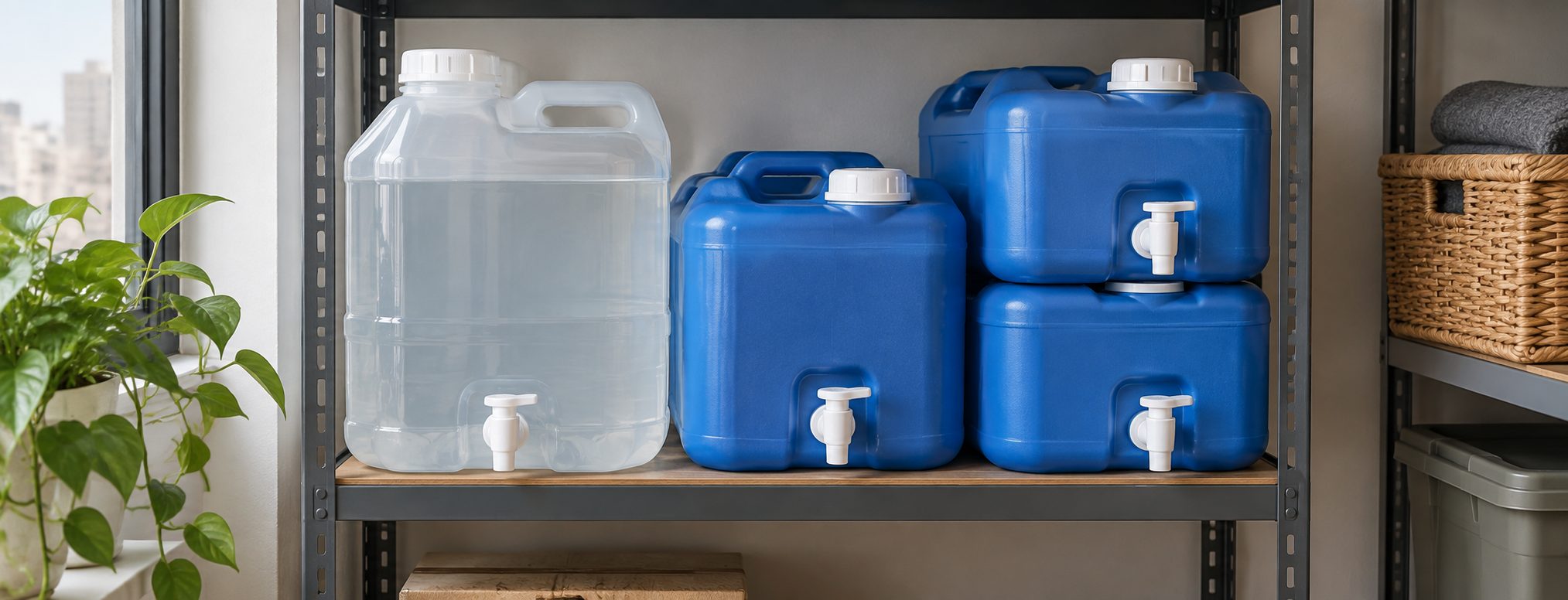
Storing enough water for an apartment or small house comes down to one constraint bigger houses don't have to solve for: floor space. A 55-gallon drum is the cheapest way to store water per gallon, but it doesn't fit in most apartment closets. This guide compares the three container types that actually work in tight spaces, stackable, rigid, and collapsible, on the things that matter once you're the one filling, moving, and pouring from them: filled weight, footprint, how easy it is to actually pour, and cost per gallon of capacity. For the full water-quantity math (how much to store per person), see our Emergency Water Kit & Storage Guide first.
Quick Picks
| Product | Type | Capacity | Filled Weight | Approx. Cost/Gallon |
|---|---|---|---|---|
| WaterBrick Stackable Container (8-pack) | Stackable | 28 gal (3.5 gal × 8) | ~29 lbs per brick | ~$4.60/gal |
| Reliance Aqua-Tainer | Rigid | 7 gal | ~58 lbs | ~$3/gal |
| Reliance Fold-A-Carrier | Collapsible | 5 gal | ~42 lbs | ~$3/gal |
Cost-per-gallon figures are approximate, calculated from typical current pricing at time of writing; check the current listing price before assuming these hold exactly.
Best Stackable Container
WaterBrick Stackable Water Storage Container (3.5 Gallon, 8-Pack)
WaterBricks are the most space-efficient option for apartments specifically because they interlock like building blocks: stack them six high against a wall, under a bed, or in the back of a closet, and the footprint is whatever floor space the base layer occupies, not the height. Each 3.5-gallon brick weighs about 29 lbs full, light enough for one person to lift and carry without straining, which matters more than it sounds like once you're actually moving water around an apartment. The narrow neck makes pouring controlled (less sloshing than a wide-mouth jug) but slower to fill initially. The 8-pack gives 28 gallons total: roughly two weeks for one adult at FEMA's 2-gallon/day recommendation.
- Interlocking stackable design: vertical storage, minimal floor footprint
- ~29 lbs filled per brick: manageable for one person to carry
- 28 gallons total per 8-pack; built-in carrying handle
Best Rigid Jug
Reliance Aqua-Tainer 7-Gallon Rigid Water Container
The Aqua-Tainer's rectangular (not round) shape is the detail that matters for small spaces: it stacks flat against itself and sits flush against a wall or shelf edge, unlike a round jerry can that wastes corner space. At 7 gallons it holds more per container than most collapsible options, which means fewer individual units to manage, but a full one weighs roughly 58 lbs: heavier than most people want to lift one-handed, so plan to fill it in place rather than carrying it full. The hideaway spout reverses into the body for storage and flips out for pouring, which is more convenient than unscrewing a cap entirely every time.
- Rectangular design: stacks and stores flush against walls/shelves
- 7-gallon capacity in one unit; reversible hideaway spout
- Food-safe, BPA-free construction
Best Collapsible Container
Reliance Fold-A-Carrier 5-Gallon Collapsible Water Container
The advantage a collapsible container has over every rigid or stackable option on this page is simple: empty, it folds flat and takes up almost no room at all, which matters if you want to keep several on hand for a larger household but don't have permanent shelf space to dedicate to them while they sit empty most of the time. Filled, it behaves like any other 5-gallon container (roughly 42 lbs full) with a built-in on/off spigot for controlled pouring. The tradeoff: a soft-sided container is more puncture-prone than rigid plastic, so it's better suited to indoor storage than being tossed in the bottom of a car trunk with sharp-edged gear.
- Folds flat when empty: minimal storage footprint until you need it
- Built-in on/off spigot for controlled pouring
- 5-gallon capacity; food-grade polyethylene
What Actually Matters When Buying One
Filled Weight Versus Who's Actually Lifting It
A container's capacity number doesn't tell you whether you can actually move it once it's full. Water weighs about 8.3 lbs per gallon, so a 7-gallon container weighs roughly 58 lbs filled, and a 5-gallon one around 42 lbs. If anyone in your household has back problems, limited mobility, or would be filling and moving these alone, smaller individual units (like the 3.5-gallon WaterBrick) that stay under about 30 lbs each are easier to handle safely than fewer, larger containers, even though it means managing more individual pieces.
Storage Footprint Versus Household Size
For a single adult's 2-week supply (about 28 gallons at 2 gal/day), one 8-pack of WaterBricks or four Aqua-Tainers cover it in roughly the same floor footprint. The real difference shows up at family scale: a family of four's 2-week supply (about 112 gallons) starts to genuinely matter whether you're stacking vertically (WaterBricks against a wall) or spreading containers across floor space (jugs under furniture), so measure your actual available storage area before committing to one container type exclusively. Our Apartment Emergency Prep guide covers the broader small-space storage math beyond just water.
Pouring and Cleaning Access
A narrow neck (WaterBrick) pours in a controlled stream but is harder to scrub inside by hand; a wide-mouth rigid jug (Aqua-Tainer) is easier to clean and inspect but sloshes more when pouring without a spout attachment. A built-in spigot (Fold-A-Carrier) is the most convenient for controlled, hands-free pouring but is one more moving part that can fail or leak over years of storage. None of these differences is disqualifying, but factor in how often you'll actually be rotating and refilling the container, not just how it looks on a shelf.
Cost Per Gallon Is Not the Whole Story
On pure cost-per-gallon, rigid jugs and collapsible containers both come in cheaper than stackable bricks. But the WaterBrick's premium buys genuinely better use of vertical space in a small apartment, where floor space, not dollars, is often the actual constraint. Decide which resource (money or square footage) is scarcer in your situation before optimizing for the other.
Water Storage Container FAQ
Can I just reuse empty milk jugs or juice bottles instead of buying containers?
Not recommended. Milk jugs are not designed for long-term storage: they degrade faster than purpose-built water containers, are difficult to fully clean of milk proteins that can harbor bacteria, and aren't rated food-safe for extended contact. Juice and soda bottles (PETE, recycling symbol 1) are a somewhat better reused option for short-term rotation if thoroughly cleaned, but a purpose-built HDPE water container is worth the modest cost for anything you intend to store for months at a time. See our Water Storage Guide for full container and rotation guidance.
Do stackable, rigid, and collapsible containers all store water for the same length of time?
Container type doesn't change how long treated water stays safe: that's governed by whether the water was treated, how well the container is sealed, and storage conditions (cool, dark, away from chemicals), not the container's shape. All three types here are food-grade HDPE and store water equally well when filled and sealed correctly. The practical difference between them is how conveniently they fit your space and how easily you can move and pour from them, not shelf life.
Should I mix container types instead of buying all of one kind?
Often yes. A common apartment setup: a stack of WaterBricks against one wall for the bulk of the stored supply, plus one or two collapsible containers stored flat for surge capacity you can fill right before a forecasted emergency (a storm warning, for example) without dedicating permanent shelf space to them year-round. Mixing types lets you optimize for both baseline storage efficiency and flexible extra capacity.