72-Hour Emergency Kit: The Complete Guide & Checklist
A 72-hour emergency kit is the single most recommended preparedness item from FEMA, the Red Cross, and Ready.gov: and for good reason. The first 72 hours after a disaster are when emergency services are most stretched and households are most on their own. Your 3-day emergency kit is what keeps your family safe during those critical hours.
This guide covers everything: what goes in a 72-hour kit, how to organise it, how much to budget, and the best products on Amazon for every category. Whether you're building a home emergency kit, a portable bug out bag, or both, this is the complete resource.
Emergency Preparedness Supplies for a 3-Day Emergency Kit
Before buying anything, sort what a 72-hour kit needs into two piles: things most households already own and just need to gather, and things worth actually buying. This keeps your first shopping trip short and cheap.
Essentials You May Already Own
- Flashlight, spare batteries, and a phone charger cable
- Blankets, extra warm clothing, and rain gear
- A backpack, duffel bag, or storage bin to hold everything together
- Printed local maps (an old road atlas or state map works)
- A manual can opener from the kitchen drawer
- Cash set aside (ATMs and card readers may not work)
- Copies of ID, insurance cards, and important documents
Optional Products After the Basics
Once the free/already-owned items are gathered, these purchases give you the most protection per dollar: a NOAA weather radio, a water filter or purification tablets, a comprehensive first aid kit (see our Best First Aid Kits guide), a portable power bank, and non-perishable food matched to your household (see our Non-Perishable Food List). If your emergency turns into an extended outage rather than a 3-day event, our Extended Power Outage Guide covers what to add beyond this baseline.
What Is a 72-Hour Emergency Kit?
A 72-hour emergency kit: also called a 3-day emergency kit or FEMA emergency kit: is a collection of supplies that allows your household to survive independently for 72 hours without external support. It's designed for scenarios where utilities are out, stores are closed, and emergency services are overwhelmed: hurricanes, earthquakes, major storms, extended power outages.
A 72-hour kit can be organised two ways:
- Home-based kit: Supplies stored at home in a dedicated container (a bin, bag, or shelf) for sheltering in place
- Portable bug out bag: Supplies packed in a backpack ready to grab and go if evacuation is necessary
Ideally, you have both. The home kit is larger and more comprehensive; the bug out bag is portable and pre-packed for a rapid departure.
FEMA Emergency Supply List: Sources and Additions
The list below is reproduced from Ready.gov's official "Build a Kit" guidance, FEMA's consumer-facing emergency preparedness site. It's the baseline every household should have:
- Water: 1 gallon per person per day for at least 3 days
- Food: at least a 3-day supply of non-perishable items per person
- Battery-powered or hand-crank radio for NOAA weather alerts
- Flashlight and extra batteries
- First aid kit
- Whistle to signal for help
- Dust mask / N95 respirator
- Plastic sheeting and duct tape for shelter-in-place
- Moist towelettes, garbage bags, and plastic ties for sanitation
- Wrench or pliers to turn off utilities
- Manual can opener
- Local maps (printed)
- Cell phone with chargers and a backup battery
This is the baseline FEMA publishes for a general audience. Based on field experience, we recommend these additions beyond the official list: a comprehensive first aid kit rather than a basic one (see First Aid below), a backup water purification method in addition to stored water (see Water below), and a portable power bank since phone battery life is rarely accounted for in the official list. The sections below expand on each category with specific quantities and product picks.
72-Hour Kit Contents by Household Size
FEMA's list doesn't scale by household size on its own: here's how the core consumable categories scale from one adult to a family of four with pets, using the same per-person FEMA baselines (1 gallon water/person/day, 3-day food supply) applied across this page.
| Category | 1 Adult | 2 Adults | Family of 4 | Family of 4 + Pets |
|---|---|---|---|---|
| Water (3 days) | 3 gal | 6 gal | 12 gal | 15+ gal |
| Food (3-day supply) | 1 person's worth | 2 people's worth | 4 people's worth | 4 people's worth + pet food |
| Flashlights/headlamps | 1 | 2 | 4 | 4 |
| First aid kits | 1 comprehensive | 1 comprehensive | 1 comprehensive + travel-size for bags | Same + pet first aid basics |
| Cash on hand | $100 | $150 | $250 | $250+ |
| Backpack/bin size | 1 daypack | 1 duffel or 2 daypacks | 1 large bin + 1 grab bag | Add a pet supply tote |
Multiply the water and food rows directly by headcount; items like radios, can openers, and document folders don't scale with household size: one per household is enough. For a deeper household-size breakdown across multiple duration tiers, see our Extended Power Outage Guide, which extends this same framework to 2-week supplies.
Water: The Non-Negotiable First Priority
Water is your most urgent need. You can survive weeks without food; you'll begin suffering serious effects in 24 hours without water and face death within 3 days. Always build your water supply first, before everything else.
How Much Water for 72 Hours?
| Household Size | 3-Day Supply | Recommended Storage |
|---|---|---|
| 1 person | 3 gallons | 1 × 5-gallon jug or 3 × 1-gallon bottles |
| 2 people | 6 gallons | 2 × 5-gallon jugs or 6 × 1-gallon bottles |
| 4 people | 12 gallons | 3–4 WaterBrick containers |
| 6 people | 18 gallons | 4–5 WaterBrick containers |
Add 50% more for households with infants, nursing mothers, people doing physical labour, hot climates, or anyone with medical conditions.
Water Storage Options
- Commercial bottled water: Simplest option. Buy cases and rotate every 12 months.
- WaterBrick containers: 3.5-gallon BPA-free bricks that stack. Most space-efficient option for homes.
- 5-gallon jugs: Standard emergency water containers. Affordable but awkward to store.
- WaterBOB bathtub bladder: Fills your bathtub with 100 gallons before a storm. Excellent if you have advance warning.
For container comparisons, rotation schedules, and a full home-vs-go-bag breakdown, see our complete Emergency Water Kit & Storage Guide.
Water Purification Backup
Always have a backup purification method in case stored water runs out:
- Water filter straw (LifeStraw, Sawyer Squeeze): Filters bacteria and parasites from any source
- Water purification tablets: Iodine or chlorine tablets: very compact, excellent for a bug out bag
- Boiling: 1 minute at a rolling boil kills all pathogens: requires a camp stove
72-Hour Emergency Food Supply
For a 72-hour food supply, you need approximately 2,000 calories per adult per day, 1,400–1,600 per child, and 3,000+ for anyone doing heavy physical work. Prioritise non-perishable items that require minimal preparation.
Food for a 72-Hour Kit Without Cooking
These need no water, heat, or cooking equipment: useful for the first day of any emergency when you may not have a safe way to cook yet. For the complete 50-item list with shelf life and prep method for every food, see our Non-Perishable Food List.
- Canned beans, tuna, chicken (protein + calories, ready to eat)
- Canned vegetables and fruit
- Peanut butter or nut butter (dense calories, 2-year shelf life)
- Crackers, hardtack, rice cakes
- Granola bars, protein bars, trail mix
- Dried fruit and nuts
- Honey (indefinite shelf life)
- Emergency food bars (Datrex, Mayday): 3,600 cal per pack, 5-year shelf life
Three-Day Meal and Quantity Example
Concrete quantities are easier to shop from than a category list. Here's a worked example for one adult at roughly 2,000 calories/day using shelf-stable, mostly no-cook items; multiply by household size for your own kit.
| Day | Breakfast | Lunch | Dinner | Snacks | Approx. Calories |
|---|---|---|---|---|---|
| Day 1 | Granola bar + dried fruit | Canned tuna + crackers | Canned chili or beans (no-cook or heated) | Peanut butter packet, trail mix | ~1,900–2,100 |
| Day 2 | Instant oatmeal (needs hot water) | Peanut butter + crackers | Canned chicken + canned vegetables | Protein bar, dried fruit | ~1,900–2,100 |
| Day 3 | Granola bar + nuts | Canned beans + rice cakes | Emergency food bar (3,600 cal covers this plus reserve) | Trail mix, honey packet | ~1,900–2,100 |
This example totals roughly 9 individual food items per adult for 3 days: pack a matching quantity of manual can openers, spoons, and disposable plates. Add 500–800 extra calories/day for anyone doing heavy physical work (see the calorie ranges above).
Choosing the Best Food for a 72-Hour Kit
Preparation, Water, Dietary Needs, and Rotation
- Preparation: Favor no-cook and add-water-only items over anything needing a stove, especially for the first 24 hours. Have at least one cooking method as backup: a propane camp stove with 2–3 extra fuel canisters, a butane stove, or a portable rocket stove, plus a lighter and waterproof matches.
- Water needed for prep: Instant oatmeal, freeze-dried meals, and powdered milk all need water you must budget separately from your drinking supply: see our Emergency Water Kit guide for how to size that in.
- Dietary needs: Check every item against food allergies, diabetes, or other household dietary restrictions before buying in bulk. Freeze-dried meal kits (see our Freeze-Dried Food Guide) often have clearer allergen labeling than generic canned goods.
- Rotation: Check expiration dates every 6 months; use FIFO (first in, first out) by eating older stock in normal meals and replacing it, rather than letting a kit sit untouched for years.
Shelter, Warmth & Light
Warmth
- Emergency mylar blankets (1+ per person: under $2 each, reflect 90% body heat)
- Sleeping bag rated to 20°F or lower (cold-climate households)
- Extra warm clothes and rain gear
- Hand warmers (chemical, last 8–12 hours)
- Wool blanket (retains warmth even when wet)
Light
- LED flashlight (1 per adult) + extra batteries
- Headlamp (1 per person): hands-free, essential for night-time tasks
- LED lantern: lights a room, not just a beam
- Emergency candles + waterproof matches
- Glow sticks: safe light for children, mark evacuation routes
Shelter
- Emergency tarp or poncho (if bugging out)
- Plastic sheeting + duct tape (shelter-in-place for chemical/biological events)
- Tent (for extended bug-out scenarios)
Communication & Information
- Hand-crank or battery NOAA weather radio (all 7 channels)
- Printed family emergency plan with contact numbers
- Portable battery bank / power bank (10,000+ mAh for phone charging)
- Walkie-talkies (FRS/GMRS radios for family communication)
- Written local maps: GPS fails, phones die, paper maps don't
First Aid
- Comprehensive first aid kit (100+ pieces)
- Tourniquet (CAT or SOFTT-W): for traumatic bleeding
- Prescription medications (90-day supply if possible)
- OTC medications: ibuprofen, acetaminophen, antihistamine, antidiarrheal
- Prescription eyeglasses (spare pair if you wear them)
- Hand sanitizer and soap
- N95 masks (at least 4 per person)
- Latex-free examination gloves
Documents & Financial Prep
- Copies of passports, birth certificates, Social Security cards
- Insurance policies (home, auto, health, life)
- Bank account information
- Property deeds and vehicle titles
- Medical records, vaccination records
- Emergency contact list (printed)
- Physical cash: $200–$500 in small bills
Store all documents in a waterproof bag or case. A fireproof document bag that also fits in your bug out bag is ideal.
Special Needs Items
For Infants and Young Children
- Formula or breast milk storage
- Baby food and snacks
- Diapers (3-day supply)
- Baby wipes and rash cream
- Comfort item (favourite toy or blanket)
For Pets
- 3-day supply of pet food
- Water and collapsible bowl
- Medications and vaccination records
- Leash, carrier, and comfort item
For Elderly or People with Disabilities
- Backup hearing aids and batteries
- Spare glasses or contacts
- Mobility device supplies
- Medical alert information card
Recommended Products for Your 72-Hour Kit
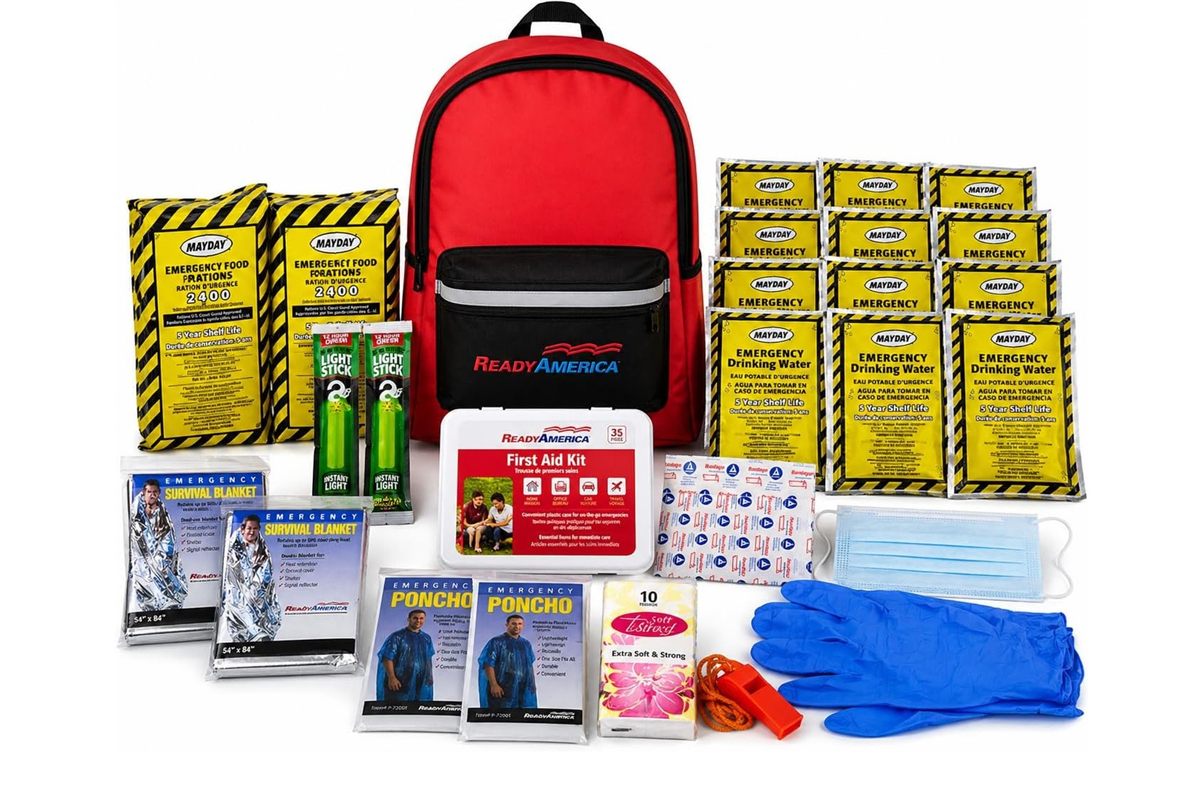
Ready America 70380 Emergency Kit, 4-Person 3-Day
The best single-purchase starter option. This all-in-one backpack covers every FEMA-listed item for a family of four. Ideal for households that want to be prepared immediately without building from scratch.
- 4-person, 72-hour supply in one backpack
- Food bars, water pouches, first aid, light, emergency tools included
- FEMA and Red Cross aligned contents
WaterBrick Standard 3.5-Gallon Water Storage (4-Pack)
Four WaterBricks hold 14 gallons: enough for a family of four for 3.5 days. They stack, they're BPA-free, and they last indefinitely when stored correctly. The best water storage solution for households without a garage or basement.
- 3.5 gallons each, stackable, BPA-free
- Airtight lids approved for long-term water storage
- More practical than 5-gallon jugs: easier to lift and store
Midland ER310 Emergency Hand-Crank Weather Radio
The gold-standard NOAA emergency radio. Charges via hand-crank, solar, or USB; receives all 7 NOAA channels; includes a built-in LED flashlight and USB phone charger. This is the one device we recommend to every household building a 72-hour kit.
- All 7 NOAA weather alert channels
- Hand-crank + solar + USB charging
- Built-in flashlight and USB phone charger output
Anker 26800mAh Portable Power Bank
A high-capacity power bank that charges most smartphones 5–6 times from a single charge. In a power outage, your phone is your lifeline: this keeps it alive. Anker is the most reliable brand in portable charging at a fair price point.
- 26,800mAh: 5–6 full phone charges
- Three USB outputs: charge multiple devices simultaneously
- Anker's 18-month warranty
Frequently Asked Questions
What food should I put in a 72-hour emergency kit?
Prioritize no-cook, ready-to-eat items for the first day (canned proteins, peanut butter, crackers, granola and protein bars), then add items that need only water or brief heating (instant oatmeal, freeze-dried meals) for days two and three. Budget roughly 2,000 calories/adult/day, 1,400–1,600/child. See the Three-Day Meal and Quantity Example above for a worked example, and our Non-Perishable Food List for the full 50-item reference.
What is the FEMA 72-hour kit recommendation?
FEMA recommends every household maintain at minimum: 1 gallon of water per person per day for at least 3 days, a 3-day supply of non-perishable food, a battery or hand-crank radio, a flashlight, a first aid kit, a whistle, and a manual can opener. This is the absolute minimum: we recommend expanding to at least 7 days for most households.
Should a 72-hour kit be kept at home or in a bag?
Both, ideally. Keep a larger home-based kit for sheltering in place, and a portable bug out bag pre-packed for rapid evacuation. If you can only do one, make it the home kit first (easier, cheaper, more likely needed) and add a portable bag later.
How often should I update my 72-hour emergency kit?
Review and refresh at least twice per year: spring and fall when clocks change is a good reminder. Rotate food (FIFO: first in, first out), replace expired medications, check battery levels, and update your family communication plan if anything has changed.
How much does a 72-hour kit cost?
For a single adult, $50–$80. For a family of four, $100–$150 for a solid kit. Premium versions with better food, a quality bag, and expanded first aid can run $200–$300. See our complete budget guide: Prepping on a Budget: Under $100.
Is 72 hours really enough?
It's the minimum starting point, not the ideal target. Major disasters (Katrina, Sandy, the 2021 Texas freeze) showed households needed to be self-sufficient for 5–14 days. FEMA itself has revised guidance upward, encouraging households to build toward 2 weeks. Start with 72 hours, then work toward 14 days over time.
What is the difference between a 72-hour emergency kit and a 72-hour survival kit?
They're the same thing with different names. "72-hour emergency kit," "72-hour survival kit," "3-day emergency kit," and "72-hour bag" are all interchangeable terms for a pre-packed supply kit covering 72 hours of self-sufficiency. FEMA and the Red Cross tend to use "72-hour emergency kit"; many preppers say "72-hour survival kit"; retailers often call it a "3-day kit." The contents and purpose are identical - the only difference is who's talking about it.
Download the Free Checklist
Subscribe to our newsletter and get the printable 72-Hour Emergency Kit Checklist PDF: all items on one page, organised by category.
Get the Free Checklist →