National Grid Power Outage Risk 2026: What Data Centers Are Actually Doing to the Grid
Headlines are warning about a possible national grid power outage as AI data centers pull electricity faster than the grid can add it. That part is true. What most coverage leaves out: your own outage is still far more likely to come from an ice-covered tree branch than a generation shortfall, and in January 2026 the federal government invoked a 1935 wartime law to push data centers onto diesel generators specifically to keep residential power on. Here's what the actual grid data, the diesel-generator order, and Winter Storm Fern show, plus exactly how to prepare no matter which risk shows up at your house first.
Is a National Grid Power Outage Actually Coming?
Electricity demand is growing faster than new supply for the first time in roughly three decades, driven mostly by AI data centers - and winter peak demand is now growing faster than summer peak in several regions for the first time in generations. That part of the story is real. But "the grid is strained" and "a national grid power outage is coming" are two very different claims, and the data only supports the first one.
- Roughly 90% of customer outage-minutes come from local distribution failures - downed trees, ice on lines, broken poles - not from a shortage of generation. (Congressional Research Service)
- 80% of major US outages between 2000 and 2023 were weather-caused, not capacity-caused. (Climate Central)
- Winter Storm Fern proved it in real time: 1.1 million+ customers lost power in January 2026, but almost none of it was a capacity shortage - it was ice snapping poles and tree limbs. PJM never ordered rolling blackouts.
- The Summer 2026 outlook actually improved: NERC dropped elevated-risk regions from six down to three after 58 GW of new generation came online.
Why Data Centers Are Suddenly the Story
US data centers consumed an estimated 176-183 TWh in 2023-24, about 4.4% of national electricity (LBNL / CRS). A newer estimate puts total US data center draw at 67.7 GW - roughly 6% of US electricity, up 36% in two years. Global data center demand hit 787.8 TWh in 2025, nearly doubling in five years, and the US alone consumes close to 40% of that global total.
- Goldman Sachs projects US data center power demand climbing from 31 GW (2025) to 41 GW (2026) to 66 GW (2027).
- Data centers' share of US peak summer demand: 4.1% (2025) → 5.3% (2026) → a projected 8.5% by 2027.
- Gartner projects global data center power hitting 290 GW by 2030, more than doubling in four years.
- ERCOT (Texas) alone expects 45 GW of large loads to interconnect by 2030 - 23 GW of it data centers.
- Up to $700 billion in US data center spending is anticipated in 2026 alone.
Data centers also stress the grid differently than older industrial loads. They run 24/7, which flattens the load curve and stretches the peak demand period from a two-hour morning spike into sustained, all-day-and-night high load. That makes battery state-of-charge management much harder during a multi-day cold event - NERC has explicitly warned that grid-scale batteries could be depleted, with "little time to recharge," during a Uri-scale storm. Demand-response programs, meanwhile, are contractually capped to limited hours and limited frequency, so they can't just absorb unlimited data center growth.
Data Centers Ordered Onto Diesel Backup: The Section 202(c) Story
This is the most newsworthy, least-covered part of the story. Section 202(c) of the Federal Power Act - passed in 1935 - lets the Energy Secretary compel emergency grid action. It was used roughly 29 times in the eight decades before 2026 (22 of those during WWII). Since 2000 it had been invoked about 26 times total, almost always for hurricanes or sudden equipment failures.
- Jan 22-27, 2026: During Winter Storm Fern, PJM requested and DOE granted a 202(c) order authorizing data center customers who volunteered to switch to their own backup generation - freeing grid capacity for homes. Parallel orders went to NYISO and Duke Energy.
- May 18, 2026: A new DOE order let PJM curtail data centers and large loads with backup generation as a last resort before rolling blackouts.
- June-July 2026: Facilities with 50 MW+ peak load were ordered to switch to their own backup generators within 15 minutes of an emergency signal. Hospitals, 911 centers, water treatment, and defense installations are exempt.
- By late July 2026: DOE had issued this class of authorization six times, covering roughly 30 states - including the highest concentrations of data centers in the country.
Important honesty point: as of this writing, PJM says it has not actually implemented the order - no data center has been forced off the grid. These are standing authorizations, not executions. Worth noting for balance: the backup generators involved are mostly Tier 2 diesel units, among the more polluting generation permitted under EPA rules, and they're concentrated in communities already near data center campuses.
Case Study: Winter Storm Fern (January 22-26, 2026)
Fern is the freshest, most useful anchor for what a real national-scale winter grid event looks like - and it's the second-deadliest US winter storm in modern history after Uri.
- Stretched more than 2,000 miles, from the Four Corners to Maine.
- Temperatures as low as -43°F; winter alerts covered 230 million people - about two-thirds of the US population.
- 24 governors declared states of emergency; presidential emergency declarations began Jan 23 for twelve states.
- Peak outages: about 1.1 million customers across the ten hardest-hit states.
- 174 fatalities attributed to the storm; preliminary damage estimates exceed $4 billion.
- Restoration ran beyond two weeks in the worst ice-damaged counties. Mississippi took about two weeks to reach 98% restoration.
- Primary cause: freezing rain and ice accretion - over an inch in parts of northern Mississippi - loading down conductors, crossarms, and poles until they broke.
On the grid side: PJM approached an all-time winter peak near 147,000 MW and served above 130,000 MW for seven straight days, a streak it had never experienced. Generation outages peaked above 22 GW mid-storm. Spot wholesale prices briefly topped $3,000/MWh. And still: no rolling blackouts were ordered anywhere. That single fact matters more than almost anything else in this article.
The lesson: the grid held. The poles didn't. A household that prepared for "rolling blackouts" and not for "twelve days without power because the pole down the street snapped" prepared for the wrong thing.
What This Is Already Costing You
Even without a single blackout order, data center growth is already showing up on residential electric bills - mainly through capacity market prices, the fee grid operators charge to guarantee enough power plants exist for future peak demand.
- PJM's capacity price jumped from $28.92/MW-day in 2024/25 to $269.92 in 2025/26 - an 833% single-year increase, the sharpest in the capacity market's 27-year history.
- PJM's independent market monitor attributes 63% of that jump - about $9.3 billion - directly to data center demand.
- The 2027/28 and 2028/29 PJM capacity auctions both cleared short of the reliability target - the first back-to-back shortfalls in the market's history.
- Retail utility supply rates across PJM's territory are up 5% to 44% since June 2025. Pepco customers in DC, for example, saw bills rise roughly $21/month starting mid-2025.
A policy backlash is already underway: Oregon created the first dedicated data-center electricity rate class, Virginia's SB 253 would shift more infrastructure cost onto data centers instead of households, at least six states have floated construction moratoriums, and Texas ordered a full audit of its data-center grid-connection queue.
What Actually Kills People in a Winter Outage
Ranked by actual risk, not by what's easiest to sell:
1. Carbon Monoxide - the leading preventable killer
An estimated 100 Americans die every year from generator carbon monoxide poisoning, and more than half of all US CO deaths happen in November, December, January, and February. A gasoline generator produces as much CO as hundreds of cars.
2. Hypothermia
1,024 US deaths were attributed to excessive cold or hypothermia in 2023, with January the deadliest month. About 60% of hypothermia deaths occur in people over 65, and rates are generally higher in rural areas where response times are longer.
3. House fires from improvised heating
Space heaters and improvised heat sources are consistently paired with CO poisoning in winter safety advisories - the same devices that risk carbon monoxide buildup are frequently a fire-department callout waiting to happen when left unattended or placed near combustibles.
The Timeline Inside Your House
A moderately insulated home stays "bearable" for roughly 8-12 hours after heat is lost. After 24 hours, indoor temperature is trending toward whatever it is outside. Wind accelerates this dramatically by stripping the warm boundary layer off exterior walls.
| Outdoor Temperature | Unprotected Pipe Freeze Time | Insulated Pipe Freeze Time |
|---|---|---|
| 20°F to 32°F | ~12 hours | Slower - low single-digit days possible |
| At or below 20°F | As little as 3 hours | ~6 hours |
| Single digits or below 0°F | A few hours | 6-24 hours (exterior walls/crawlspaces fastest) |
The pipe doesn't burst where the ice is - it bursts in the liquid-filled section downstream, where trapped pressure has nowhere to go. A slightly open faucet gives that pressure an escape route, which is the real mechanism behind the old "leave a tap dripping" advice. Keep indoor temperature above 55°F if at all possible; frozen-pipe damage commonly runs $5,000+ once water damage is included.
Food: discard anything exposed to 40°F or higher for two hours or more. Keep the fridge and freezer doors shut - a full freezer stays safely cold far longer than a half-empty one. Water: Ready.gov's baseline is 1 gallon per person per day, but utility guidance for winter storms specifically recommends 3-5 gallons per person per day once you account for drinking, cooking, sanitation, and manually flushing toilets if pumps fail.
Is Your Region at Higher Risk This Winter?
| Region | Winter Risk Driver | Notes |
|---|---|---|
| PJM (13 states + DC, 67M people) | Data center load growth + plant retirements | Two straight capacity auctions cleared short of target |
| ERCOT / Texas | Data centers, industrial load, gas freeze-offs | Only state with mandatory gas weatherization rules |
| MISO | Load growth outpacing new resource additions | Declared an Energy Emergency Alert during Fern |
| New England | Constrained gas pipelines; falling firm imports | Stored fuel depletes fast in extended cold snaps |
| Southeast (SERC-East) | Electrified heating shifting it to dual-peaking | Winter peak forecast rising while firm capacity declines |
| Pacific Northwest | Drought, low snowpack, hydro dependence | Winter peak up 9.3% year over year; increasingly import-dependent |
| WECC-Basin (UT, S. ID, W. WY) | Could run up to 1.6 GW short under extreme derates | External help may not exist in a region-wide event |
| Maritimes | Below its reliability reference margin | The only assessment area not meeting its own target |
How to Actually Prepare: Backup Power Tiers
Most people assume a gas furnace still works in an outage. It doesn't - the blower motor, control board, electronic ignition, and safety sensors all need electricity. A residential gas furnace typically draws 400-700W running, with a startup surge of 2-3× that as the blower motor kicks on.
- Hours of coverage: A ~1,000Wh power station runs a 600W furnace for roughly 2-3 hours continuous, longer once you factor in the furnace's normal on/off duty cycle.
- A night or two: A ~2,000Wh power station with pure sine wave output and 2,000W+ AC capacity is the practical minimum for furnace-plus-essentials coverage overnight.
- A multi-day ice storm restoration (Fern-scale): Requires either a generator for periodic recharging, solar panels to top the battery up daily, or both. This is the single most important honesty point in backup power planning - most portable power stations cover a furnace for a few hours, not a 9-14 day restoration window.
Running your existing gas furnace off a battery is far more fuel- and power-efficient than trying to generate heat electrically with a space heater - a 1,500W resistance heater burns through the same battery in a fraction of the time a 600W furnace blower does. Lead with the furnace, not the heater.
Recommended Products
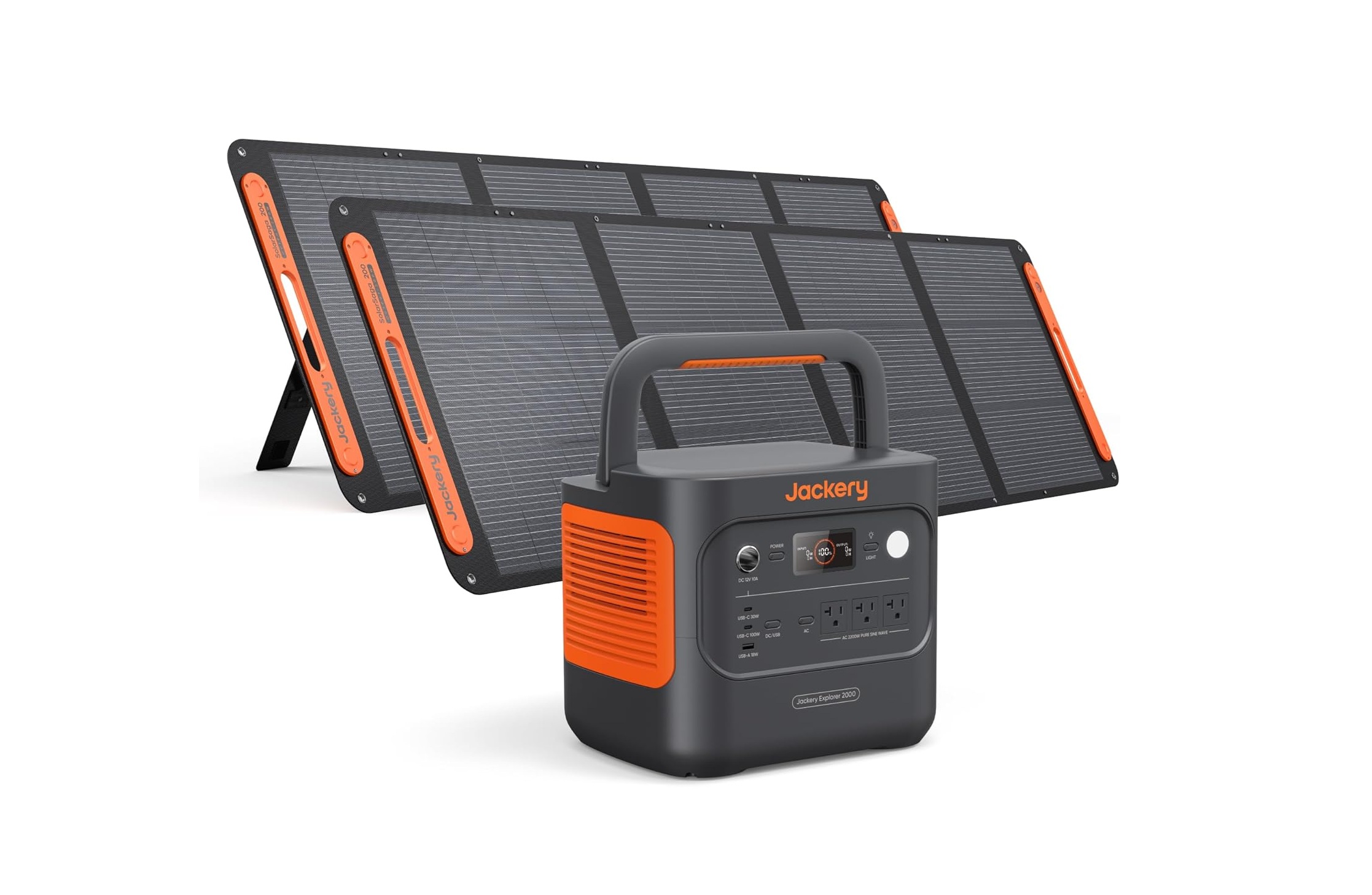
Jackery Explorer 1000 v2 Portable Power Station
If a repeat of Winter Storm Fern knocks your power out for a week while crews reset broken poles, this is the piece of equipment that changes the outcome. A 1,264Wh LiFePO4 battery with 2,000W AC output (surging to 4,000W) has enough headroom to start a gas furnace blower motor, run a CPAP all night, or keep a fridge cycling. Pair it with solar panels and it recharges indefinitely instead of running out on day two. At $799 and roughly 29 lbs, it's a serious investment and not something you'd grab in two seconds on the way out the door.
- 1,264Wh LiFePO4 battery - long cycle life
- 2,000W AC output, 4,000W surge - enough to start a furnace blower
- Solar-compatible for indefinite off-grid recharge
Anker 625 Solar Panel (100W Portable Solar Charger)
A power station is only as good as its next charge - this is the piece most people skip and regret on day three. This foldable 100W solar power charger recharges a compatible power station directly in full sun, or tops off phones and small electronics through its own USB-C port. IP67 weatherproofing means it can sit outside through the storm itself. Pair one with a 1,000-1,500Wh power station and a sunny day covers most of a full recharge without burning any gasoline. Output depends entirely on direct sun, so cloud cover or poor panel angle can cut real-world charging well below the rated 100W.
- 100W foldable monocrystalline solar panel
- IP67 weatherproof - safe to leave outside during a storm
- Direct USB-C output; compatible with most major power stations
Kidde Battery-Powered Carbon Monoxide Detector (Digital Display)
CO poisoning is the leading preventable killer in a winter power outage - about 100 Americans die from generator carbon monoxide every year, and more than half of all US CO deaths happen between November and February. This detector runs on battery alone, so it still works when the grid doesn't, and its digital display shows the actual parts-per-million reading rather than just a pass/fail alarm. Put one on every level of the house, mandatory outside every sleeping area. The battery needs periodic replacement per the unit's rated sensor life, so check the date rather than assuming a working alarm is a permanent fixture.
- Battery-powered - works with zero grid power
- Digital PPM display, not just a pass/fail alarm
- Recommended: one per floor, required outside every sleeping area
Frost King Automatic Electric Heat Cable (Pipe Freeze Protection)
Unprotected pipes can freeze in as little as 3 hours once temperatures sit at or below 20°F, and a burst pipe commonly runs $5,000+ in repairs once water damage is factored in. This self-regulating heat cable wraps directly onto exposed pipe runs - crawlspaces, exterior walls, unheated basements - and switches on automatically near 38°F, so it's already protecting the pipe before anyone's awake to open a faucet. Cheap insurance against the single most common outage-related property damage claim. It needs grid power to run, so during an actual outage it won't protect pipes unless you have a backup power source keeping it energized.
- Self-regulating - activates automatically near 38°F
- Protects the highest-risk locations: crawlspaces, exterior walls, unheated basements
- A fraction of the cost of a single burst-pipe repair
National Grid Power Outage FAQ
Is the US national power grid actually going to fail because of AI data centers?
Almost certainly not in the way "grid collapse" implies. NERC's own 2025-26 assessment found every region has adequate resources for a normal winter peak, with only 7 areas flagged for extreme, wide-area cold. The real story is a thinner safety margin: demand grew 20.2 GW in one winter while new resources added only 9.4 GW, and just 1,335 MW of that was new generation. That's a strained system, not a collapsing one. The bigger, statistically likelier risk to any individual household remains a local distribution failure - a downed line or broken pole - which causes roughly 90% of all outage-minutes nationwide.
What is Section 202(c) and why are data centers being put on diesel generators?
Section 202(c) is a 1935 federal law that lets the Energy Secretary order emergency grid actions. In January 2026, during Winter Storm Fern, DOE used it to authorize PJM to switch data centers and other large loads onto their own backup diesel generators, freeing grid capacity for homes. By late July 2026, similar orders had been issued six times, covering roughly 30 states. As of this writing, PJM says it has not actually forced any data center off the grid - these are standing authorizations to use as a last resort before rolling blackouts, not something that has happened yet.
Should I prepare for rolling blackouts or something else?
Prepare for something else. Winter Storm Fern knocked out power to 1.1 million customers without a single rolling blackout being ordered anywhere - the outages were almost entirely downed lines and broken poles from ice, and restoration took 9 to 14 days in the hardest-hit counties. A household stocked for a short, planned rolling blackout is not stocked the same way as a household ready for two weeks without power because a pole snapped down the street. Plan for the multi-day, unplanned, no-set-end-date outage - that's the one that actually happens.
How fast do pipes actually freeze without power?
Faster than most people expect. At sustained temperatures at or below 20°F, unprotected pipes can freeze in as little as 3 hours, and insulated pipes in about 6. Between 20°F and 32°F, it takes roughly 12 hours. Pipes running through exterior walls, crawlspaces, or attics freeze fastest. Keep indoor temperature above 55°F if at all possible, and open a faucet slightly on at-risk lines - a trickle of moving water gives trapped pressure an escape route and genuinely prevents bursts.
Do I need a whole-home generator, or is a portable power station enough?
For most households, a mid-size portable power station (1,000-1,500Wh, 1,800-2,000W AC) paired with a solar panel covers what actually matters in an outage: a gas furnace's blower and control board, a CPAP, phone charging, LED lighting, and a fridge cycled a few hours a day. A whole-home generator or a larger expandable battery system makes more sense if you have well-pump dependence, medical equipment with high continuous draw, or you've decided that two weeks without grid power - Fern's worst-case restoration time - is a realistic planning target where you live.
Sources
Grid reliability, government, and public-health sources are cited directly; news coverage is paraphrased and linked. This article reflects data available as of August 28, 2026, and will be updated when NERC's 2026-27 Winter Reliability Assessment is released in November.
- NERC, 2025-26 Winter Reliability Assessment
- NERC, 2025 Long-Term Reliability Assessment
- NERC, 2026 Summer Reliability Assessment
- PowerOutage.com, Winter Storm Fern analysis
- US Department of Energy, PJM Section 202(c) application, Jan 2026
- Congressional Research Service, Data Centers and Their Energy Consumption (R48646)
- Congressional Research Service, Weather-related outage and distribution-grid report
- Goldman Sachs, US data center power demand forecast
- Gartner, 2026 data center electricity demand forecast
- Forbes, US share of global data center electricity
- Utility Dive, DOE emergency order coverage
- IEEFA, PJM capacity price analysis
- FERC, Winter Storm Uri final report
- FERC / NERC, Winter Storm Elliott final report
- EIA, 2024 US power interruption statistics
- CPSC, Winter carbon monoxide safety warning
- CDC, MMWR hypothermia deaths by month, 2023
- Ready.gov, Winter Weather preparedness guidance
- FEMA, 2024 National Household Survey analysis