Best Portable Jump Starters for Car Emergency Kits (2026)
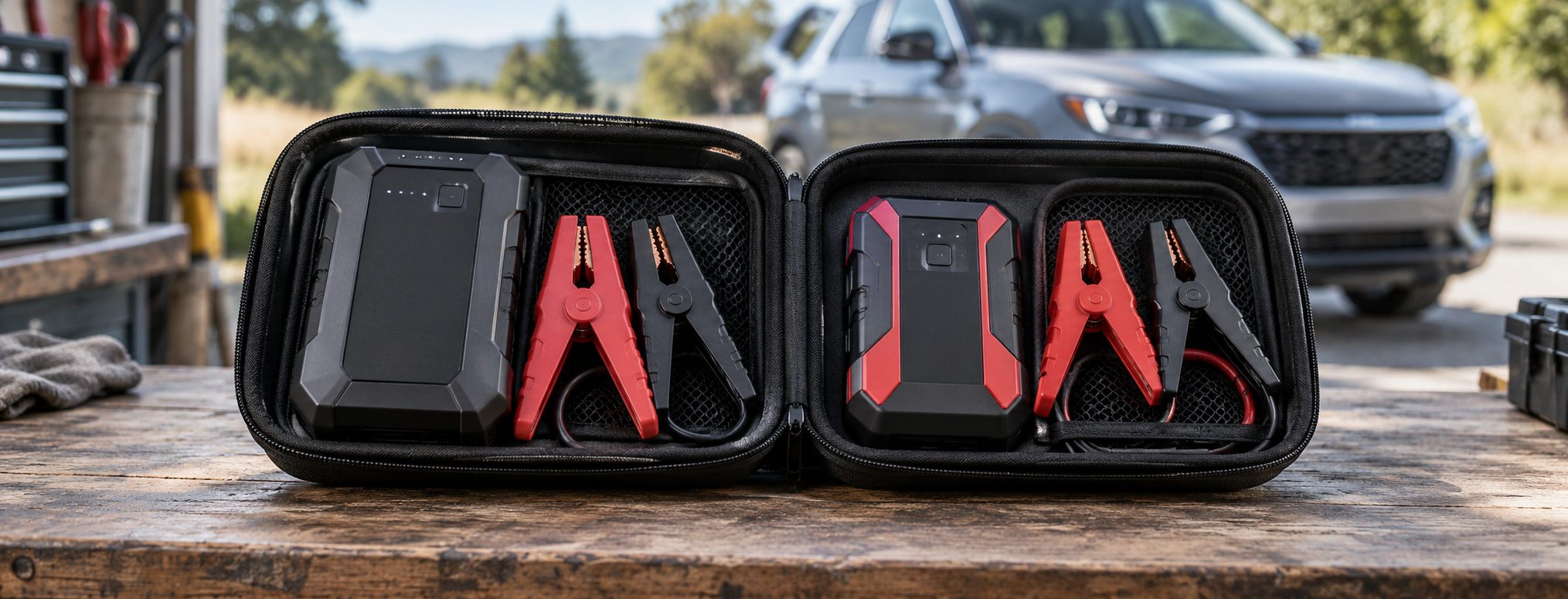
A dead battery stops an evacuation before it starts, and it's one of the few roadside failures a portable jump starter lets you fix yourself in under a minute, no other vehicle or stranger required. This guide compares a compact everyday-carry unit, a larger heavy-duty pack rated for bigger engines, and a jump-starter/inflator combo, on the specs that actually matter: what engine size it's rated for, how much glovebox space it takes up, how often you need to recharge it, and what's genuinely included versus sold separately.
Quick Picks
| Product | Type | Peak Amps | Engine Limit | Price |
|---|---|---|---|---|
| NOCO Boost Plus GB40 | Compact | 1,000A | 6.0L gas / 3.0L diesel | ~$50 |
| NOCO Boost HD GB70 | Heavy-duty | 2,000A | 8.0L gas / 6.0L diesel | ~$200–$250 |
| NOCO Boost+Air AX65 | Jump starter + inflator combo | 2,000A | 8.0L gas / 6.0L diesel | ~$210–$300 |
Best Compact Jump Starter
NOCO Boost Plus GB40: Best for Everyday-Carry Storage
At 2.5 lbs and small enough to fit in most gloveboxes, the GB40 is the jump starter people actually keep in the car rather than leaving in a garage. Rated for 1,000 peak amps, it covers the large majority of passenger cars, SUVs, and small trucks (up to 6.0L gas or 3.0L diesel), which is enough for most household vehicles but not for larger diesel trucks. NOCO rates it for up to 20 jump starts on a single charge, and it doubles as a USB power bank and 100-lumen flashlight, so it earns its glovebox space even between actual jump-start uses. The IP65 rating means dust and water exposure in a trunk or glovebox isn't a real concern.
- 1,000A peak; covers up to 6.0L gas / 3.0L diesel engines
- 2.5 lbs; up to 20 jump starts per charge
- Doubles as USB power bank + 100-lumen flashlight; IP65 rated
Best Heavy-Duty Jump Starter
NOCO Boost HD GB70: Best for Trucks and Larger Diesel Engines
If your household includes a diesel truck, a full-size SUV, or anything beyond an ordinary sedan, the GB40 above is genuinely undersized for the job. The GB70 steps up to 2,000 peak amps and covers up to 8.0L gas or 6.0L diesel engines, roughly double the GB40's rated capacity, and NOCO rates it for up to 40 jump starts per charge. It's meaningfully larger and more expensive than the compact pick, so it's the right choice specifically because your vehicle needs the extra output, not as a default upgrade for a car the GB40 already covers comfortably.
- 2,000A peak; covers up to 8.0L gas / 6.0L diesel engines
- Up to 40 jump starts per charge
- Spark-proof connections and reverse polarity protection
Best Jump Starter + Inflator Combo
NOCO Boost+Air AX65: Best 2-in-1 for a Single-Purchase Car Kit
A flat tire and a dead battery are two of the most common reasons a car doesn't move, and the AX65 covers both from one device: the same 2,000A/8.0L-gas/6.0L-diesel jump-starting capability as the GB70, plus a 100 PSI air compressor rated to inflate a tire from 0 to 40 PSI in about 2 minutes. The tradeoff is price and complexity: you're paying a real premium over buying a jump starter and a separate 12V tire inflator individually, and a combo device means both functions are unavailable if the unit itself fails. It's the right pick if glovebox space is genuinely tight and you'd rather carry one device than two.
- 2,000A jump starting; same engine coverage as the GB70
- 100 PSI air compressor, 0–40 PSI in about 2 minutes
- One device instead of two separate tools
What Actually Matters When Buying One
Match the Amp Rating to Your Actual Engine, Not the Biggest Number
Peak amp ratings sound like a straightforward "more is better" spec, but a jump starter's rating needs to match your specific engine, not exceed it for its own sake. A 1,000A compact unit is genuinely sufficient for the large majority of gas passenger vehicles; paying for 2,000A capacity you'll never need mainly buys extra size and weight. Check your vehicle's engine displacement (in the owner's manual or on a printed sticker under the hood) against the jump starter's rated engine limit before assuming bigger is automatically better.
Recharge Intervals and Storage Discipline
A jump starter that's been sitting dead in a glovebox for a year is useless exactly when you need it. Lithium jump starters like the ones above hold charge for months, but manufacturers generally recommend recharging every 3-6 months even if unused, and immediately after any use. Pair your jump-starter check with your other seasonal vehicle kit reviews (see our Car Emergency Kit guide) so it isn't a separate thing to remember.
What's Actually Included Versus Sold Separately
Check the actual listing, not just the product name, for what ships in the box: some jump starter listings are for the unit alone, with the carrying case, extended cables, or accessories sold as an add-on kit. This matters more for the combo and heavy-duty units, where accessories (air compressor hose attachments, heavier-gauge cables) can meaningfully affect real-world usability.
Cold Weather Performance
Jump starters are disproportionately needed in cold weather, since cold reduces a car battery's cranking capacity in the first place, but lithium batteries themselves also lose some capacity in extreme cold. If you live somewhere with genuinely cold winters, keep the jump starter somewhere it experiences less temperature swing than a trunk left outside overnight where possible, and check the charge level more often in winter months. See our Winter Car Emergency Kit guide for the broader cold-weather vehicle kit.
Portable Jump Starter FAQ
Are lithium jump starters safe to keep in a car year-round?
Generally yes for models with built-in protection circuitry (spark-proof connections, reverse polarity protection, over-charge/over-discharge protection), which all three picks above include. Extreme heat is harder on lithium batteries than cold, so a car that regularly sits in direct summer sun is a slightly less ideal long-term storage spot than a shaded space, but this is a minor factor for most households rather than a reason to avoid keeping one in the vehicle.
Do I need a heavy-duty jump starter if I just drive a regular sedan?
No. A compact 1,000A-class unit like the NOCO GB40 covers the engine size of the large majority of passenger cars and small SUVs. Heavy-duty units earn their higher price and larger size specifically for bigger engines: full-size trucks, larger SUVs, and diesel engines. Buying more capacity than your vehicle needs mainly costs you extra money and glovebox space.
Can a jump starter replace jumper cables entirely?
For jump-starting your own vehicle, yes: a portable jump starter needs no second vehicle, which is its main advantage over traditional cables. Keeping a set of jumper cables as a backup is still reasonable, since they have no battery to discharge and can be used with any other vehicle's battery as the power source if your jump starter itself is ever dead or lost.