Best Manual Can Openers for Emergency Food Supplies (2026)
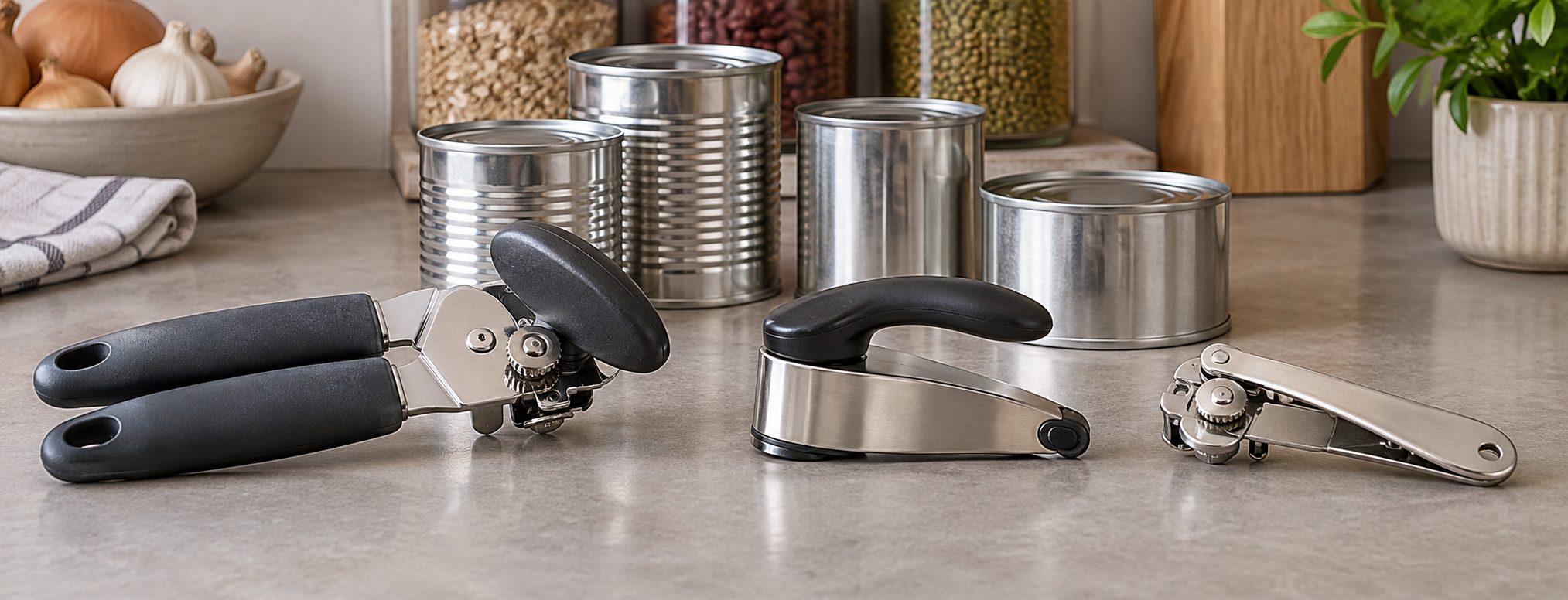
A stocked pantry of canned food is useless during a power outage if the only can opener in the house is electric. It's one of the cheapest, most overlooked items in emergency preparedness: a $10-25 manual can opener that's easy to grip and reliable is worth more than its price suggests. This guide compares a conventional handheld opener, a smooth-edge safety opener, and a compact folding military-style opener, on grip effort, reliability across repeated use, ease of cleaning, and suitability for users with limited hand strength or arthritis.
Quick Picks
| Product | Type | Best For | Price |
|---|---|---|---|
| EZ-DUZ-IT Can Opener | Conventional handheld | Reliable everyday kitchen use | ~$17 |
| OXO Good Grips Smooth Edge | Smooth-edge safety | Limited hand strength, arthritis, zero sharp edges | ~$25 |
| GI P-38 Can Opener (5-pack) | Compact folding | Go-bags, keychains, ultimate backup redundancy | ~$8 (5-pack) |
Best Conventional Handheld Opener
EZ-DUZ-IT Can Opener: Best Conventional Handheld Opener
The EZ-DUZ-IT has been a kitchen-drawer staple for decades for a reason: it's a simple, gear-driven crank mechanism that reliably punctures and cuts around a standard can lid without the learning curve or higher price of newer safety designs. It's the classic style most people already know how to use without instructions, which matters during an actual emergency when you don't want to be figuring out an unfamiliar tool. It does leave a sharp-edged lid behind, unlike the smooth-edge pick below, so handle the removed lid with care.
- Simple, reliable gear-driven crank mechanism
- Familiar classic design: no learning curve
- Leaves a sharp edge on the removed lid; handle with care
Best Smooth-Edge Safety Opener
OXO Good Grips Smooth Edge Can Opener: Best for Limited Hand Strength
Independent kitchen-gear testers consistently rank this as the top overall can opener, and the reason matters specifically for emergency use: its smooth-edge cutting wheel slices along the side of the lid rather than through the top, leaving zero sharp edges on either the can or the removed lid. Combined with large, soft-grip ergonomic handles and a gear-driven mechanism that needs minimal twisting force, it's the right choice for anyone in the household with arthritis, weaker grip strength, or anyone you can't guarantee will handle a sharp lid carefully under stress. This is the pick if only one can opener is going in the emergency kit.
- Smooth-edge cutting: zero sharp edges on can or lid
- Large ergonomic soft-grip handles; minimal twisting effort required
- Best choice for arthritis or limited hand strength
Best Compact Folding Opener
GI P-38 Can Opener: Best Compact Backup
The P-38 has been standard U.S. military field-ration equipment since World War II, and the reason it's still made and sold today is that it works: a single folded piece of stamped steel, small enough to fit on a keychain, with essentially nothing to break. It requires more technique and hand effort than either opener above (there's a real learning curve to using one efficiently), which is exactly why it's a backup rather than a primary pick: keep the OXO or EZ-DUZ-IT as your main kitchen opener, and stash a P-38 in every go-bag, glovebox, and small kit as redundancy that takes up essentially zero space or weight.
- Tiny, keychain-sized; virtually indestructible stamped steel
- Sold in multi-packs cheaply enough to put one in every bag
- Requires more technique than a handheld opener: practice before relying on it
What Actually Matters When Buying One
Grip Effort Matters More Than It Seems
Opening a single can with a stiff, hard-to-turn opener is a minor annoyance in normal life. Opening several cans a day for a family, potentially by someone with reduced hand strength from age, injury, or arthritis, during a stressful emergency is a meaningfully different situation. Prioritise a gear-driven mechanism with a large, soft-grip turning knob over a purely mechanical crank that requires more consistent hand pressure.
Buy More Than One
A can opener is small and cheap enough that redundancy costs almost nothing: keep your primary opener in the kitchen drawer where it always lives, a second one specifically in your emergency food storage area (not assuming you'll remember to grab the kitchen one), and a compact folding opener in every go-bag and vehicle kit. Losing access to the one can opener in the house over something this inexpensive is an avoidable failure.
Smooth Edge Versus Sharp Edge Isn't Just About Safety
Beyond avoiding cuts, a smooth-edge opener that separates the lid cleanly from the can also makes it easier to reseal a partially-used can with foil or a lid, and avoids sharp metal edges ending up loose in a food-storage area or go-bag where hands reach in blind. This is a genuine quality-of-life difference for regular use, not just a marketing distinction.
Manual, Not Electric, for Emergency Storage
An electric can opener is faster in daily use but is completely useless during a power outage, precisely the scenario your stored food supply exists for. Keep at least one fully manual opener specifically for your emergency food supply, even if your household's everyday kitchen opener is electric. See our Non-Perishable Food Stockpile List for the broader shelf-stable food list this pairs with.
Manual Can Opener FAQ
Why do I need a manual can opener if I have an electric one?
An electric can opener requires power, which is exactly what's unavailable during the power outages and disasters that make your canned food stockpile important in the first place. A manual opener stored with (or near) your emergency food supply ensures you can actually access your stored food when the power is out, which is the scenario the stockpile exists for.
How do I use a P-38 can opener if I've never used one before?
Practice before you need it in an actual emergency: it has a genuine learning curve compared to a handheld crank opener. The short version: hook the small blade under the can's rim, pivot it down to puncture, then rock the tool forward and back while walking it around the rim, re-hooking every inch or so. It's slower and more effortful than a handheld opener, which is why it's recommended as backup redundancy rather than your primary opener.
Do I need a smooth-edge opener, or is a regular one fine?
A conventional opener works fine for most people and is a reasonable, cheaper choice for a primary kitchen opener. A smooth-edge model is worth the modest price difference specifically if anyone in the household has arthritis, reduced grip strength, or if you want to eliminate the sharp-edge risk entirely, especially relevant if children might help with food prep during an emergency.