Best Food Storage Buckets for Long-Term Emergency Supplies (2026)
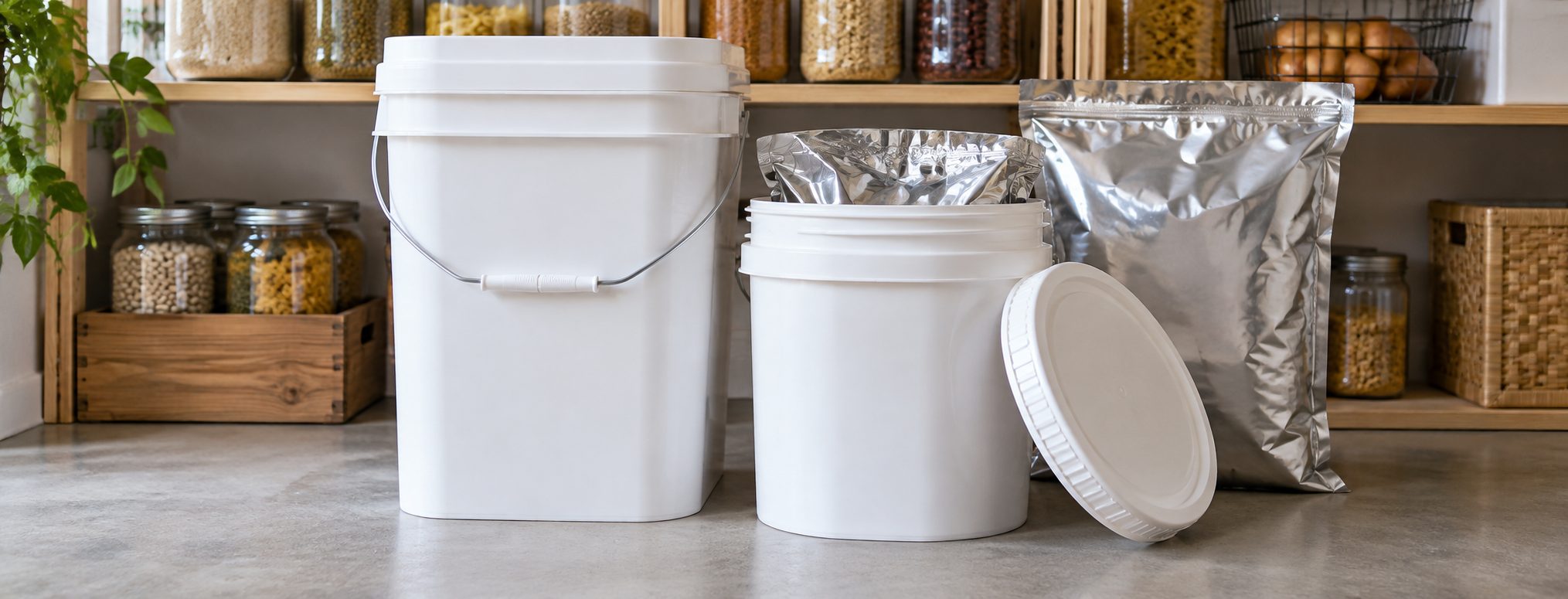
A Mylar bag protects bulk food from oxygen and light, but it still needs something rigid around it to resist rodents, crushing, and accidental punctures during years of storage: that's the job a food-grade bucket does. This guide compares a standard 5-gallon food-grade bucket, a Gamma Seal screw-top lid upgrade, and smaller stackable buckets for households with less storage space, on lid compatibility, how much a filled bucket actually weighs, stackability, and the real cost of the complete bucket-and-lid setup, not just the bucket alone.
Quick Picks
| Product | Type | Capacity | Price |
|---|---|---|---|
| Food-Grade 5-Gallon HDPE Bucket | Standard bucket | 5 gal | ~$8–$12 |
| Gamma Seal Lid (5-Gallon) | Screw-top lid upgrade | Fits standard 5-gal buckets | ~$15–$20 |
| Food-Grade 2-Gallon Stackable Bucket | Smaller stackable | 2 gal | ~$8–$12 |
Best Standard Food-Grade Bucket
Food-Grade 5-Gallon HDPE Bucket: Best Standard Long-Term Storage Bucket
Not every plastic bucket is safe for direct food contact: the ones worth buying are made of HDPE (recycling symbol 2) and explicitly certified food-grade, which matters both for what leaches into your food over years of storage and for keeping pest odours out that non-food-grade plastic can retain from previous use. A standard 5-gallon bucket holds roughly 30-35 lbs of dry goods like rice or beans depending on density, pairs with a Mylar bag liner and oxygen absorbers for the actual long-term seal, and its uniform wall thickness is designed for stacking multiple buckets without crushing the ones underneath. Buy new, food-grade-certified buckets specifically for food storage rather than repurposing a used bucket of unknown origin.
- Food-grade HDPE (#2 plastic): safe for direct food contact
- Holds ~30-35 lbs of dry goods depending on density
- Designed for stacking; pairs with Mylar liners and oxygen absorbers
Best Screw-Top Lid Upgrade
Gamma Seal Lid: Best Screw-Top Lid for Buckets You Access Regularly
A standard snap-on bucket lid needs to be pried off with a tool and pressed back on with real force, which gets old fast if it's a bucket you're actually rotating through regularly (rice, flour, pet food) rather than sealing once and opening only in an emergency. The Gamma Seal replaces the standard lid with a two-piece design: an outer ring that snaps on once and stays, and an inner lid that screws in and out by hand, giving you a genuinely resealable, no-tool-needed bucket. It's an added cost on top of the bucket itself, so it's worth it specifically for buckets you'll open often, not necessarily every bucket in a long-term storage stack you seal once and don't touch for years.
- Two-piece design: outer ring stays on, inner lid screws in/out by hand
- No tools needed to open, unlike a standard snap-on lid
- Best value for frequently-accessed buckets, not necessarily every bucket in long-term storage
Best Smaller Stackable Bucket
Food-Grade 2-Gallon Stackable Bucket: Best for Smaller Households and Tight Storage
A full 5-gallon bucket weighs 30-35+ lbs filled, which is genuinely difficult for some people to lift, carry, or store on a shelf rather than the floor. A 2-gallon bucket holds proportionally less but stays under about 12-15 lbs filled, manageable for most people to lift onto a shelf one-handed, and several smaller buckets are easier to distribute across multiple storage spots (a closet shelf here, under a bed there) than one large bucket that needs a single dedicated floor spot. The tradeoff is a higher total cost per gallon of capacity, since you're buying and managing more individual containers for the same total storage volume.
- Stays under ~12-15 lbs filled: manageable for most people to lift one-handed
- Fits shelf storage better than a 5-gallon bucket that needs floor space
- Higher cost per gallon of capacity than a single larger bucket
What Actually Matters When Buying One
Always Verify Food-Grade Certification, Not Just Color or Source
A white bucket is not automatically food-grade, and a used bucket from a restaurant or hardware store may have held non-food chemicals that leached into the plastic. Buy buckets explicitly labeled food-grade (look for the HDPE #2 recycling symbol plus an explicit food-grade claim from the manufacturer) and new rather than used, specifically for anything you intend to store dry food in for years.
The Bucket Alone Doesn't Seal Out Oxygen or Moisture
A bucket lid, even a good one, is not an airtight seal on its own: it primarily protects against pests, crushing, and light. For actual long-term shelf-life extension, pair the bucket with a Mylar bag liner and oxygen absorbers sized to the bucket's volume; the bucket is the outer physical protection layer, not the primary preservation method. See our Mylar Bags & Oxygen Absorbers guide for that half of the system.
Total Cost Includes the Lid
Bucket listings and lid listings are often sold separately, and a Gamma Seal lid alone can cost more than a basic bucket. When comparing cost per gallon of storage across options, add the bucket and whatever lid you're actually using, not just the cheapest bucket price you find, since the complete setup is what you're actually paying for.
Food Storage Bucket FAQ
Can I reuse a bucket that previously held something other than food?
Not recommended for long-term food storage. Plastic can absorb odours and residues from whatever it previously held (paint, chemicals, non-food items), and even a thorough wash may not remove everything at a level safe for food contact over months or years of storage. Buy new, certified food-grade buckets specifically for food storage rather than repurposing a used bucket of unknown history.
Do I need a Gamma Seal lid on every bucket, or just some?
Just the buckets you'll open regularly. For food you're rotating through often (flour, rice, pet food), the no-tool resealing is worth the added cost. For a long-term bucket you seal once with a Mylar liner and oxygen absorbers and don't plan to open for years, the standard snap-on lid that comes with the bucket is adequate and saves the extra cost.
How much food does a 5-gallon bucket actually hold?
It depends on the food's density: roughly 33-35 lbs of white rice, about 30-35 lbs of dry beans, and less by weight (but similar by volume) for lighter items like rolled oats. As a rule of thumb, budget one 5-gallon bucket per roughly 30-35 lbs of a dense dry good you're storing, and check specific weight-per-bucket figures for the particular food you're storing rather than assuming a single number applies to everything.