Best Waterproof Document Bags for Emergency Evacuation (2026)
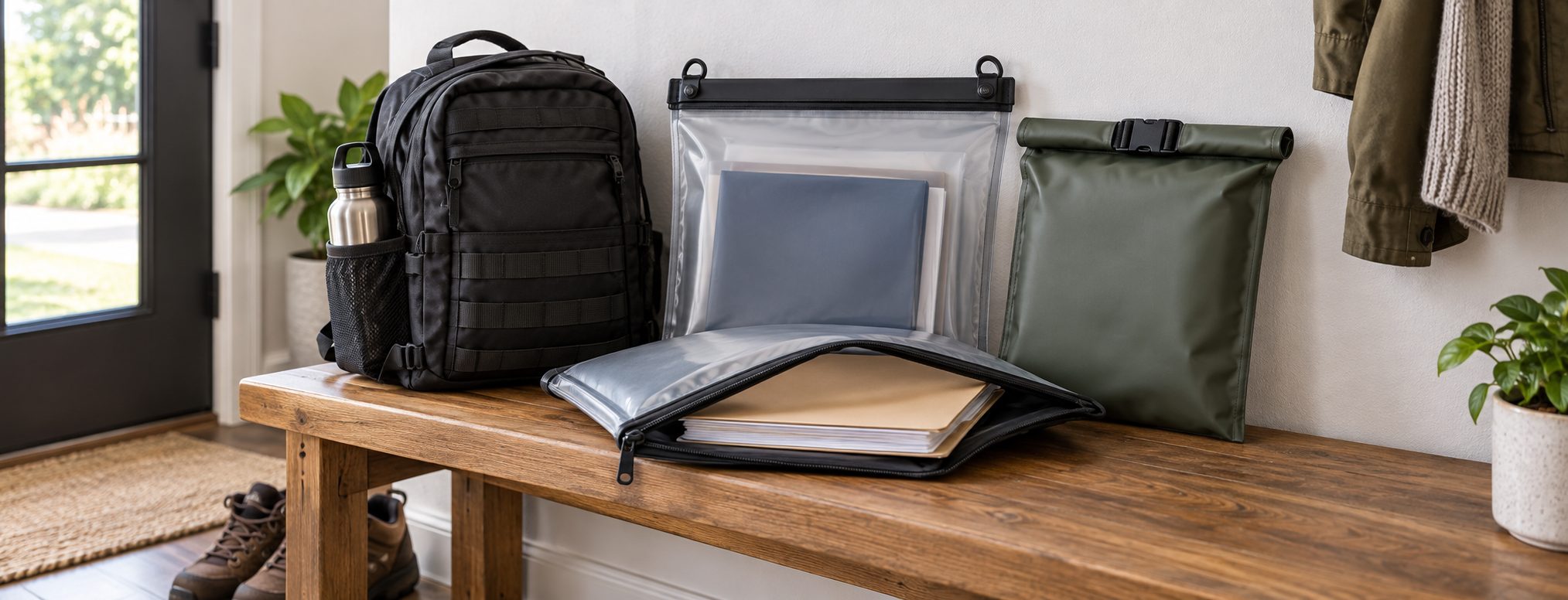
Your passport, birth certificates, insurance policies, and property deeds are some of the hardest things to replace after a disaster, and some of the easiest to protect in advance. A waterproof document bag takes minutes to set up and dramatically simplifies recovery if you ever need to evacuate or if your home floods. This guide compares a resealable roll-top bag, a rigid hard-shell case, and a fireproof zippered pouch, on usable document sizes, how the closure actually seals, and the water-resistance limits each one is rated for. One important distinction up front: waterproof and fireproof are not the same protection, and this guide is explicit about which is which for each pick.
Quick Picks
| Product | Type | Waterproof Rating | Fireproof? | Price |
|---|---|---|---|---|
| aLOKSAK Resealable Bag (8x11, 2-pack) | Roll-top/resealable | Certified to 200 ft submersion | No | ~$10–$15 |
| Pelican 1060 Micro Case | Rigid hard-shell | IP67, 1m for 30 min | No | ~$25–$50 |
| ROLOWAY Fireproof & Waterproof Document Bag | Zippered pouch | Water-resistant (splash/brief immersion) | Yes, rated | ~$24 |
Best Resealable Roll-Top Bag
aLOKSAK Resealable Waterproof Bag (8×11 Inch, 2-Pack)
The aLOKSAK isn't a bag you'll use once and store; the resealable track closure (similar to a heavy-duty zip-top bag, not a roll-top with buckles) opens and closes as many times as needed without degrading, which matters if these documents are ones you occasionally need to access. Sized at 8x11 inches, it fits standard letter documents, passports, and a phone or small tablet. It's certified waterproof to 200 feet, far beyond what an evacuation scenario actually requires, which mostly matters as a sign of seal quality rather than a spec you'll ever need in full. It is not fireproof: this is a submersion and moisture barrier only.
- Resealable, reusable closure: opens and closes repeatedly without degrading
- 8x11 inches: fits letter-size documents and passports
- Certified waterproof to 200 ft submersion; not fireproof
Best Rigid Hard-Shell Case
Pelican 1060 Micro Case
A soft bag protects documents from water but not from being crushed, bent, or punctured in a packed go-bag. The Pelican 1060's rigid polymer shell adds genuine impact and crush protection on top of an IP67 waterproof rating (submersible to about 1 meter for 30 minutes), at the cost of being bulkier and less flexible to pack than a flat pouch. It's sized more for a passport, phone, and a folded stack of critical papers than a full file of letter-size documents, so it complements rather than replaces a larger document bag for bulkier paperwork.
- Rigid, crush-resistant polymer shell
- IP67 waterproof: submersible to ~1m for 30 minutes
- Best for a passport, phone, and a small stack of critical documents, not bulk paperwork
Best Fireproof + Waterproof Pouch
ROLOWAY Fireproof & Waterproof Document Bag with Lock
If the household risk you're most worried about is a house fire rather than a flood or evacuation, this is the category that actually addresses it: the aLOKSAK and Pelican picks above are waterproof but offer no fire protection at all. The ROLOWAY bag adds a fire-resistant liner rated to protect contents during brief fire exposure, silicone-coated fiberglass construction, and a zippered closure with a small combination lock for basic security. Its water resistance is meant for splashes and brief exposure (such as fire hose runoff), not sustained submersion, so it's a complement to a true waterproof bag for evacuation, not necessarily a full replacement.
- Fire-resistant silicone-coated fiberglass construction
- Water-resistant zipper closure; combination lock included
- 15x11 inches: fits letter/A4 documents, cash, and small valuables
What Actually Matters When Buying One
Waterproof and Fireproof Are Not the Same Thing
This is the single most important distinction on this page: a bag rated for water resistance is not necessarily rated for fire, and vice versa. Read the specific certification claims rather than assuming "protective document bag" covers both risks. If you're worried specifically about house fires, look for an explicit fire rating (usually stated as a time and temperature, like "30 minutes at 1550°F"), not just "heat resistant" marketing language.
Match Bag Size to What You'll Actually Store
A passport-and-phone case and a full letter-size document folder solve different problems. Decide what you're actually protecting, birth certificates and property deeds need a letter-size bag; a passport, some cash, and a phone fit in something much smaller, before choosing a size, rather than buying the biggest option by default and ending up with a bag that's awkward to pack.
What to Actually Put Inside
Prioritise documents that are genuinely hard to replace or that unlock replacing everything else: government-issued ID, passports, birth certificates, social security cards, property deeds and titles, insurance policies, and a list of account numbers and emergency contacts. Photocopies or a USB drive with scanned copies are a reasonable supplement, not a full substitute, since originals are sometimes required. See our Safeguarding Documents guide for the complete list and organisation approach.
Where the Bag Actually Lives Matters
A document bag stored in the same spot you'd grab a go-bag from is genuinely useful during an evacuation; one buried in a closet you'd have to search for during an emergency defeats much of the purpose. Keep it with, or immediately next to, your family's go-bags and emergency plan documents, as covered in our Family Emergency Plan guide.
Waterproof Document Bag FAQ
Do I need the original documents, or are photocopies enough?
It depends on the document and the situation. Insurance claims, bank account access, and some government processes can often proceed with photocopies or digital scans, but replacing an original (a passport, a birth certificate, a property title) generally requires going through the issuing authority regardless, and having the original on hand avoids that process entirely after a disaster. A practical approach: keep true originals of the hardest-to-replace documents in your protected bag, and keep digital scans as a backup for documents where a copy is often sufficient.
Can I just use a regular ziplock bag instead of buying one of these?
A standard ziplock bag is better than nothing, but the seal quality, material durability, and actual certified water-resistance rating on a purpose-built document bag are meaningfully better, especially after being carried, handled, and potentially submerged during an actual emergency rather than sitting undisturbed in a drawer. For documents this important, the modest cost of a purpose-built bag is a reasonable insurance policy.
Should I keep my document bag in my go-bag or somewhere else?
Many households keep it inside or clipped to their primary go-bag so it automatically comes along during an evacuation. An alternative some households prefer: keeping it in a fireproof home safe for day-to-day storage, with a plan to grab it specifically during an evacuation. Either works as long as it's a location every adult in the household actually knows and can access quickly under stress.